
We've implemented Odoo Manufacturing for companies in the bicycle industry — a good example of why treating a product as one flat parts list doesn't reflect how it's actually built.
Walking through a real structure: a bicycle isn't assembled from 40 loose parts at once — it's built in stages. The frame is its own subassembly. The wheel is another, built from rim, spokes, and hub. The drivetrain is a third. Each of these has its own Bill of Materials (BoM), and those subassembly BoMs feed into the final bicycle's BoM. We configure Odoo's manufacturing workflows to mirror exactly this sequence — from individual parts, through subassemblies, to the finished bicycle — rather than forcing your real process into a flatter structure that doesn't match how your team actually builds.
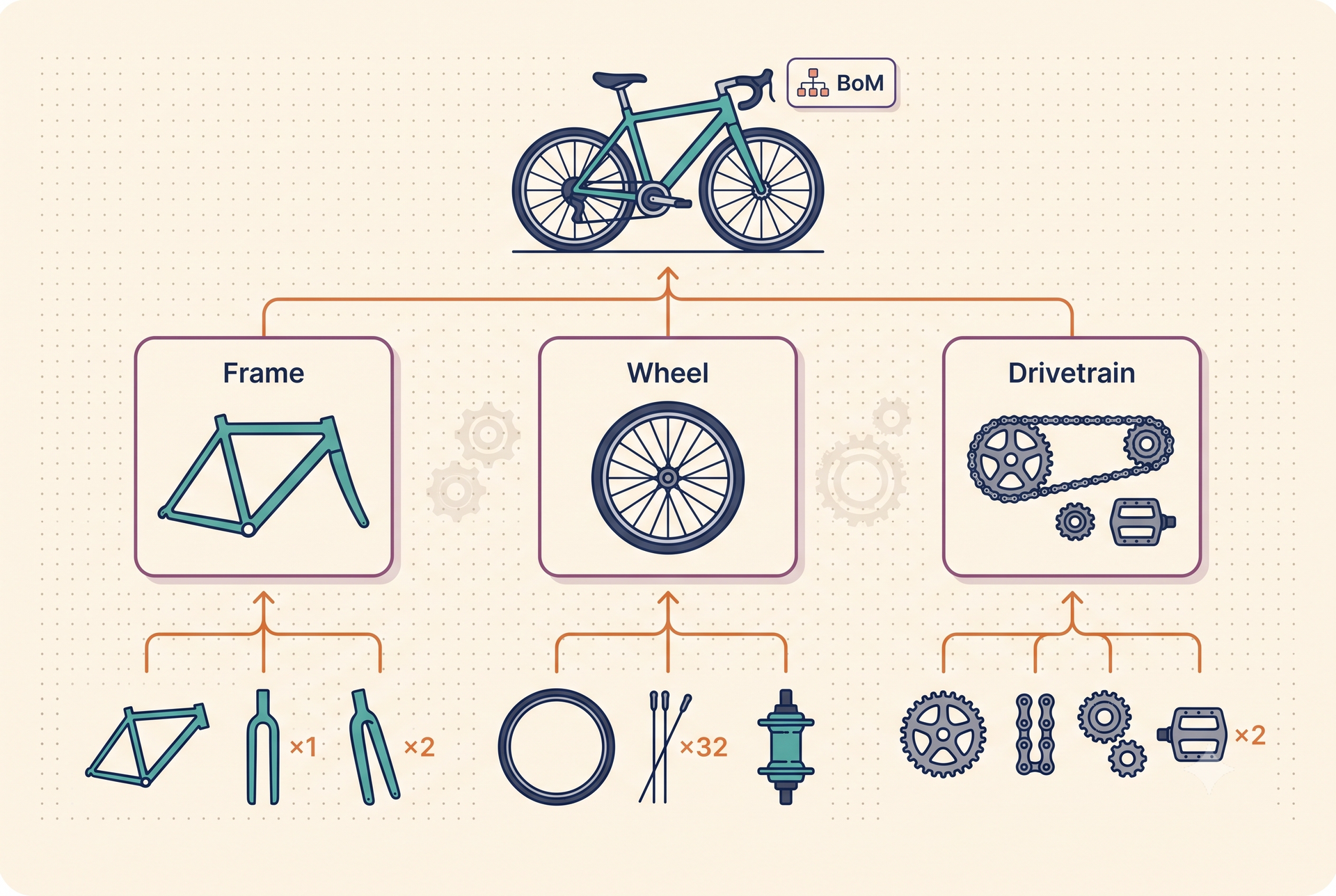
This structure isn't just about generating accurate production orders. It also feeds Odoo's planning tools: production managers can plan capacity, schedule work orders, and monitor workloads across different work centers using the same underlying data. That visibility is what lets a bottleneck get caught before it delays an order, rather than being discovered after the fact when materials or labor weren't available when needed.
Whether your business assembles products in-house with a fairly simple structure, or runs more complex, multi-stage manufacturing, the goal is the same: configure Odoo to reflect your actual production process, not a generic template that only loosely fits it.